Case file 01
The rock that was a bird
One camera logged 179 birds in three days. The checking model agreed with every one of them. Both were wrong, for different reasons.
Healthcare data analyst / Sacramento, California
I am Anna Kriuchkova. I work on the quality of California's all-payer health care claims data, in the Cost Transparency section of the Department of Health Care Access and Information (HCAI).
At home, my husband and I run our house on a private AI system we built ourselves, and I hold it to the same standard as a claims file. It has not always enjoyed this.
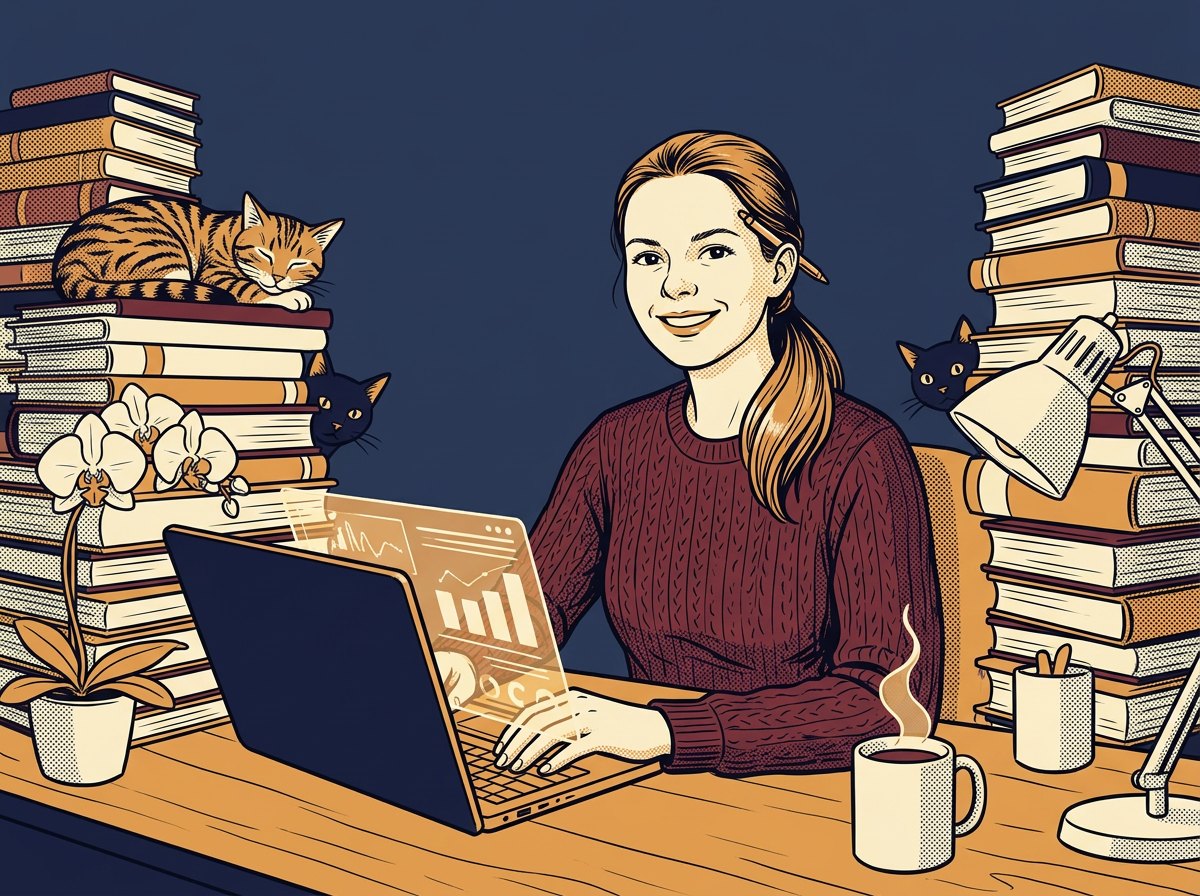
By day
California collects health care claims and enrollment records from across the state into one all-payer claims database. Before anyone can use that data to answer a question about cost or coverage, someone has to establish that it is complete, that it is consistent, and that it means what it appears to mean. That is my work.
I write SQL and Python (Pandas) to test the data, trace each discrepancy to its root cause, and automate the checks so that they run the same way every time. I build the Tableau dashboards that track data quality, present the findings to leadership, and pass what I find to the team that works with data submitters, so that problems are corrected at the source and not patched downstream.
Before HCAI, I spent nearly five years at City University of Seattle building its reporting from the database up. I hold a Master of Science in Data Science with an emphasis in artificial intelligence.
"Everybody has to feel superior to somebody. But it's customary to present a little proof before you take the privilege."
Validation and record-matching rules in SQL and Python that test claims and enrollment data for accuracy, consistency and completeness.
At HCAI, these rules reduced data discrepancies by 95%.
Dashboards that give leadership one consistent view of the data, presented in person and explained in plain language.
25+ Tableau and Power BI dashboards at City University of Seattle; Tableau data-quality dashboards at HCAI.
Manual review steps and recurring reports replaced with SQL and Python processes that produce the same result every time they run.
20+ accreditation reports automated, saving over 100 hours a year.
Detailed analyses of specific health care topics, and trend and forecasting work, summarized for the people who have to decide.
At HCAI, this analysis supports legislative and regulatory decisions.
After hours
Our house runs on a private AI system: cameras that recognize what they see, an alarm, voice assistants in the rooms, lists and reminders, and a study desk with its own search index. The cameras, the recognition and the recordings stay on hardware we own.
AI coding agents write most of the code. My part is the part I do for a living: decide what gets built, approve each change before it happens, and check the result against the evidence and not the summary. These are the case files.
Case file 01
One camera logged 179 birds in three days. The checking model agreed with every one of them. Both were wrong, for different reasons.
Case file 02
Rebuilding the notification feed so that a wrong label never reaches a phone, and finding a silent failure that had been hiding a total outage.
Case file 03
Camera vision took up to two minutes a frame. The fix was not a bigger model or more memory. It was asking the right question about the hardware.
Case file 04
Small mercies, engineered properly: laundry announcements, a doorbell that takes over the screen, and an intercom that answers back.
Case file 05
My study desk's search depended on a paid service with a shutdown date. Nothing looked broken, and nothing would have looked broken afterwards either.
Case file 06
Read-only by default, every change briefed in plain language first, and a guard that blocks destructive commands no matter how politely they are phrased.
How I work
Dashboards, status lights and confident reports are claims. I go to the rows, the frames or the logs before I believe any of them.
A validation rule that can see the expected answer, or a test that passes for the wrong reason, is decoration. I try my checks on known errors first.
Every fix ends with a plain-language record of what happened and why, so that the same mistake is not made twice by someone who was not in the room.
"We get the small truth first. Good! We keep him, and we value him; but all the same we must not let him think himself all the truth in the universe."
Off the clock
I read constantly, mostly classics and anything with dragons in it. My reading notes live in a searchable database with a few thousand saved passages, because of course they do. The quotations on this site come from it.
I speak Russian, Ukrainian and English, and I am working on German, Chinese and Korean. My first degree was in anthropology, which turns out to be good training for data work: both begin with the suspicion that the official account has left something out.
I share the house with two cats who hold strong opinions and four orchids that have names.